Showing posts with label arctic. Show all posts

10 October 2008

Arctic summer blues

Of all the evidence implicating Man's deleterious impact on the climate of the Earth, few (if any) are more unequivocal than the goings-on in the farthest reaches of the North Hemisphere, the Arctic. As the boreal summer of 2008 fades, even a brief survey of the region reveals the extent of the damage and the depth of humankind's folly...

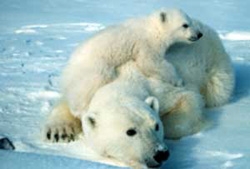
While some degree of benefit may be felt by a few segments of society in these regions (see also the Iceland video linked above...), the consequences of climate change are dire for most—both locally and globally. Polar bears are becoming increasingly endangered, as their primary habitat disappears during the summer. Some may shrug their shoulders and say 'So what?', but they fail to realize the danger. The impact of a damaged segment of the Earth system isn't necessarily localized, but rather cascades through the different interlocking 'spheres'. For example, the loss of aquatic sea otters in Alaska has effects on the terrestrial eco-system.

The final result of this ecological damage to the Arctic is ultimately unpredictable, and quite likely to be global. But it most likely won't be positive. But the prospects of the radical changes to our world needed to avert this slow-motion catastrophe don't appear to be forthcoming. Nothing will be done until it is too late. We could save the planet if we wanted, but we're too damn cheap!*

And all this gives me the blues. The Arctic Summer Blues to be exact. Imagine the music of your favorite 12-bar blues rock song ('Red House' by Jimi Hendrix is a good one...) and sing along:

The polar ice is melting...

and its getting more stormy too!

The glaciers are retreating...

as the permafrost turns to goo!

There's only one thing to do for sure...

Stop emitting CO2!!

**
Image: Science Daily. Muir glacier: August 1941, August 1950 and August 2004.

*This sentence paraphrased from 'Hocus Pocus' by Kurt Vonnegut.

15 June 2008

Scandinavia ablaze

The Scandinavian countries of Norway and Sweden are experiencing some significant wildfire activity this season, particularly during June.

Earlier this month in Sweden:

Eight helicopters and some 150 firefighters, home guards and other volunteers were Tuesday combating a large blaze that has raged for several days in central Sweden, reports said. The blaze near Hassela, some 350 kilometres north of Stockholm, was one of two blazes in the region...

A week later:

Gusting winds are fueling forest fires raging near LÀmmetorp outside of FinspÄng in east central Sweden...

Dry ground and hard winds on Tuesday caused a number of other forest fires...in south central Sweden....

    [T]he fires which have been raging for twelve days outside of Hassela in northern Sweden are now under control.

Even more recently in Norway:

Norway may seek foreign help to extinguish its biggest forest fire since World War Two, which has been raging for five days...

The fire has burned out about 5,000 acres, or 2,000 hectares, near the town of Arendal, about 260 km (160 miles) southwest of Oslo.

Norwegian media reported smoke had wafted as far as Denmark, some 120 km (75 miles) away across the Skagerrak strait.

The fire broke out after an unusually warm and sunny start to June. No lives have been lost but holiday houses have been destroyed and dozens of people evacuated.

The image was captured from the real time imagery from the NASA MODIS Terra satellite on 11 June 2008 and shows the Arendal fire. A small cluster of hotspots can be seen, along with the smoke plume extending towards Denmark. The image is a true colour image roughly 270 x 170 km, with north pointing about 20-25 degrees to the left. Oslo, Norway's capital, is just off-image to the left of the 'N' in NASA. I have slightly tweaked the image to attenuate the 'murkiness' of the original.

Compared to the sizes of wildfires which occurring the United States and other regions of the world, these fires are relatively small. But they are obviously straining the the resources of the local firefighting agencies. The largest fire since WW2 is something to take seriously.

These fires, along with those seen in Russia during April, raise an interesting question in light of a recently published paper suggesting that melting Arctic ice has a warming impact several hundreds of km inland, as well. As suggested over at Hot Topic, this is consistent with the pattern of temperatures observed this past winter with the record ice melt. These unusually warm temperatures likely played a role in producing the enhanced fire weather conditions driving the current fires. Are the carbon reservoirs within circumboreal forests at risk through increasing fire activity from the melting polar ice (as well as from the potential of melting permafrost)?

The last few years in Alaska and Yukon have seen some very severe fire seasons (e.g. Here and here). A paleo-climate record of fire activity in these regions [PDF] is more unclear. The fire activity noted this year, in both Scandinavia and Russia, could also be a sign. Obviously, one data point doesn't prove anything one way or the other. The Scandinavian fires could just be the result of short-term weather fluctuations. It will be interesting to see what happens in other northern areas this year as well. Wildfire activity is expected to be above normal this summer [PDF] in much of northern North America. The impacts of any fires need to be carefully monitored as well.

Is this case overstated? Quite possibly. Wildfire probably won't kill the forest by itself, but it could weaken the ecosystem enough to allow something else to do the job. Possibly another one of the myriad of unexpected impacts of humanity's reckless CO2-enhancement experiment. It's all happening now, and humans will know where we stand in a few years time. We can only hope it is not too late.

10 April 2008

The refutation of nonsense

Unfortunately for future generations, the idea that “global warming stopped in 1998” seems to be gaining credence in the popular imagination. The claim is that the 'global warming hoax [has been] exposed by record global cold'. These are dangerous thoughts that need to be vigorously countered with proper data analysis which accounts for the physical behaviour of the climate system.

The claims are nonsense that is at odds with what the data show. The indicators are clear –- anthropogenic climate change is a reality which isn't going away, no matter how much we may wish it to be so.

Consider the image which shows a time series of the NASA GISS annual globally-averaged temperature anomalies. Where is the lack of warming since 1998? I just don't see it. The general trend is generally ever-upward, as it has been since the mid-1970s. It is true that this year is expected to be cooler than the previous few years. It's part of the interannual variability. The recent past has been characterized by a cold Pacific ocean associated with a strong La Nina event. January and February were quite cool over parts of the globe, with unusual snow amounts and occurrences reported in some regions. But northern Eurasia experienced well above normal temperatures during these two months, and the data for March indicate that most land areas are now running well above normal. The La Nina is rapidly breaking down, and neutral conditions are returning to the Pacific.

That said, other 1-2 year periods of 'global cooling' are easily visible in the data. When the next El Nino comes -- perhaps as early as 2009-- we will likely return to record-high global mean temperatures. It's only a matter of time. Excluding the data north of about 60 N will also give an apparent 'leveling off' of temperatures and the 'no warming since 1998' idea gets 'validated'...but what exactly is that supposed to tell you? If global temperature is desired, the whole globe needs to be considered...

The apparent recovery of sea ice in the Arctic is also being used to cast doubt on the reality of climate change. After reaching record low extents in September 2007, the ice area has 'recovered', apparently providing proof of the 'hoax'. Time series plots (at left) of Arctic sea ice anomaly from Cryosphere Today, show this to indeed be the case. The ice has recovered all the way to the areas (also anomalously low) seen in 2005. Wow! The ice came back during the long polar night. Before we start making grand pronouncements about the non-validity of climate change, can we at least wait and see what happens this year (and preferably a few more after that...)? The long polar summer has just begun. Ice extent won't reach a minimum again until September. It's also true that Antarctic sea ice has been anomalously high. But there is no reason to expect a symmetric response between the hemispheres. Paleo-climate studies indicate that quite clearly.

Make no mistake, humans are affecting the climate system. The link between increasing CO2 concentrations (35% and rising!) and enhanced greenhouse warming is undeniable. It is foolhardy to do so, and this is tantamount to what climate change deniers are doing. Exactly what the effects are going to be remains uncertain, but the early indications (as detailed here on planet doom?) are not positive. Acting now to prevent the (likely) worse effects to come is crucial; when The Cataclysm occurs, it may well be too late. The source of our environmental problems is our lifestyle and the society we have created. We have reached the limits to growth; the neoliberal philosophy is bankrupt. It's time to pay the piper. Techno-solutions will ease the way, but ultimately a lifestyle change will be required to create a lasting solution.

***
Images: NASA GISTEMP and Cryosphere Today, links above

20 November 2007

Natural variability vs. climate change

Global changes in weather and climate are undoubtedly being observed. Are these signs of climate change, or of some other natural (interdecadal) variability? Does it have to be an either/or proposition? Here are two examples that highlight the importance of these questions.

A team of NASA and university scientists has detected an ongoing reversal in Arctic Ocean circulation triggered by atmospheric circulation changes that vary on decade-long time scales. The results suggest not all the large changes seen in Arctic climate in recent years are a result of long-term trends associated with global warming.

That's the lede of the story, something to give those who think it is all natural variability (i.e. skeptics) hope. But the key words are 'not all'. The authors are not claiming that global warming is not part of the picture, regardless of changes in the Arctic Oscillation. The relationship between interdecadal variability and climate change remains unclear. In fact the changes in the AO could be related to climate change.

Further highlighting this uncertainty is a report of a talk from a climate change conference in Australia.

...[S]cientists should reassess the use of El Nino as a forecasting tool because climate change seems to be altering the way weather processes like El Nino work.

..."The leverage that El Nino exerts on Australia is principally through its La Nina phase, principally through the flood phase of the El Nino cycle,"

Despite the on-going La Nina, much of Australia remains mired in drought, going on 11 years in some regions of the southeast. From a historical perspective, this should be a time of abundant rain in Australia. Is climate change having an impact on ENSO, or is this some heretofore unobserved pattern in its behaviour? Since the early-90s, when we began to observe unusual behaviour in ENSO, this debate has raged. The IPCC expects little change in ENSO, but there is low confidence in that projection.

We are undoubtedly doing something to our atmosphere and our planet on quite large scales. For example, observations show we have seriously altered the carbon cycle of the planet. In some areas, we have also changed the amount of insolation reaching the surface, due to smog and pollution. It seems inconceivable that such significant changes would not have some effect on the climate. With our relatively limited observations, we also know there are coherent patterns on very long time scales.

How much is due to each factor? Perhaps alterations in the patterns of interdecadal variability is how climate change manifests itself, or maybe climate change just exacerbates the natural patterns. We just don't know. We've never scientifically observed climate changes of this magnitude and scale before. So surprises in the behaviour of the climate system should be expected. After all, climate models are not without their flaws, but they are correct to the first order, and they do represent one of the best tools we have in our arsenal to help prevent a greater calamity for mankind.

18 September 2007

Odds and ends

A few miscellaneous news items related to previous posts on planet doom?

Just days after the post Disease and climate change, which noted the possibility of the disease Leishmaniasis extending its range comes a report detailing just that. Nine people in north Texas, in the vicinity of Dallas have been confirmed to have acquired the parasitic disease. The people who have fallen afoul of this infliction have not visited areas where the disease is endemic. "This is very strong evidence that the areas we need to consider endemic are moving north", reported the doctor confirming the diagnosis.


The melting ice of the Arctic is affecting political and social change in Greenland. While the retreat of the ice is eliminating the traditional way of life based on hunting, the warming is also allowing residents to produce potatoes and broccoli. It is also record catches of fish and creating opportunities for exploitation of mineral resources, possibly including oil. The potential wealth from mineral exploration is fueling dreams of a self-sufficient and independent Greenland, as well as creating social tensions and upheaval.


Finally, Australia's climate change woes continue. Despite a La Nina being officially declared recently(by the US, anyway. Australia still hasn't officially announced it yet...), unprecedented drought continues is the agricultural regions of the nation. Historically, La Nina years bring abundant rainfall to Australia, but the late timing and unusual temperature structure of this particular event is preventing this from occurring. As a result, the wheat harvest is likely to fail again this year, sending already high prices soaring. The wine industry, one of the leading exports, is also threatened if the drought continues. In Sydney, current water restrictions have been made permanent, in anticipation of continuing and future drought.


Worldwide, the signs continue to point towards ongoing climate change. If, as seems likely, these trends continue, we face a crisis of unprecedented magnitude. While we cannot be 100% certain these effects are due to climate change, do we really want to take the chance? It is our children's future. Let's take steps to correct our unsustainable lifestyle and give them a chance at a better life.


11 September 2007

Arctic meltdown

The news from the Arctic just keeps getting worse. The events currently unfolding in these regions are the clearest indication that something is amiss with the climate system.

The most obvious effect is the vast reduction in the areal coverage of Arctic sea ice. As of 4 September, the previously observed record low has declined still further, to 4.42 million km^2. A new update should be available in the next few days.


One result of the melting ice is that the long sought after Northwest Passage also opened to non-icebreaker ships for the first time since observations began in the 1970s. The image below, from the NASA Earth Observatory website, shows the unprecedented event from a satellite perspective.


The permafrost is also melting in many areas of the Arctic. According to the article, the feedback effects that this is likely to have are uncertain. From the article:


Permafrost collapse in peatlands tends to result in the slumping of the soil surface and flooding, followed by a complete change in vegetation, soil structure, and many other important aspects of these ecosystems...vegetation responds to the flooding with a boost in productivity. More vegetation sequesters more carbon away from the atmosphere in plant biomass.


It's not all good news, though...


...[T]he report also cautions that this flooding associated with collapsing permafrost also increases methane emissions. Methane is an important greenhouse gas, which is more powerful than carbon dioxide in its ability to trap heat in the earth’s atmosphere.


Unfortunately, the methane release will likely eventually balance or outweigh whatever the sequestration effect is observed.


There are also ominous signs that the melting of the Greenland ice sheet is accelerating (from The Independent)...


High up inside the Arctic circle the melting of Greenland's ice sheet has accelerated so dramatically that it is triggering earthquakes for the first time.

Scientists monitoring the glaciers have revealed that movements of gigantic pieces of ice are creating shockwaves that register up to three on the Richter scale.

The speed of the arctic ice melt has accelerated to such an extent that a UN report issued earlier this year is now thought to be out of date by its own authors.


The effect on ecosystems of the North is severe. Spring is now arriving about a fortnight earlier, with consequences for the biomes of the region.


A study of a range of animals and plants living in the high Arctic has revealed that many of them are responding to the earlier spring by flowering or laying their eggs significantly ahead of their normal times of the year.

On average, the breeding and flowering seasons in the Arctic have shifted by 14.5 days but some species of mosquitoes have begun laying their eggs 30 days earlier than in the mid 1990s...

...[T]he change in timing of emergence, egg-laying and flowering could disturb local food
webs with some animals appearing ahead or behind of others on which they rely for food.

The changes in the Arctic are also affecting polar bears, which are now expected to be functionally extinct in some regions as soon as 2030. Read the excellent posts on this over at Climate Progress and at The Island of Doubt.


That these changes are related to global warming seems obvious. The claims of the Deniers and doubters are disappearing faster than the Arctic ice. The time for action is now. Half-hearted, insincere measures like the recent APEC agreement won't do the job that needs to be done. The UN says that 2/3 of the emissions cuts for the future need to come from developing countries. That may be, but the developed world democracies must also play a major role -- in political and scientific leadership, in developing and implementing the appropriate policies and in financial and technical support for making the necessary adjustments. Citizens of these democracies must bring the issue of climate change to the forefront in upcoming elections and choose leaders who will lead, rather than those who deny, obfuscate and try to sustain the unsustainable status quo. It is the only way forward.